Nutrition Facts Panel: Serving Sizes, Servings Per Container, and Calories
Nutrition Facts Panel: Serving Sizes, Servings Per Container, and Calories
Most people have seen a Nutrition Facts panel thousands of times, yet many are still unsure what the information means or how to use it. Even with the updates that rolled out a few years ago, confusion about serving sizes and calories remains one of the biggest issues I see in practice. The panel is a helpful tool, but only if you know what you are looking at and what the numbers are actually telling you. This is my job – I share how to interpret the information. People decide whether or not to look at it, apply it, and make any adjustments based on the information.
This is the first part of a four-week series breaking down the Nutrition Facts panel into pieces that make sense for everyday life. Hopefully, with no complicated nutrition jargon (sometimes I don’t realize I am doing that). Just what you need to know so you can pick up a food or beverage, read a label, and understand what you are about to eat – or not. Today is all about serving sizes, servings per container, and calories.
But first, I need to clarify that not every food requires a Nutrition Facts label. Alcohol falls under a different agency. Coffee, tea, and spices typically have no measurable nutrition to list. Foods you buy at a deli counter for later (like prepared salads) do not require labels. Raw fruits and vegetables are exempt unless the store chooses to post the info nearby. Bulk foods often rely on the nutrition information posted on the original packaging (think of the bag of Halloween candy where the individual candies don’t have the nutrition information, but the original package does). And cuts of meat now require Nutrition Facts, but the label will not list servings per container because the weights vary.
With that out of the way, let’s address the information you actually see printed on the panel. Again, this is part 1 of a 4-part series, so the information is divided into parts.
Serving Sizes
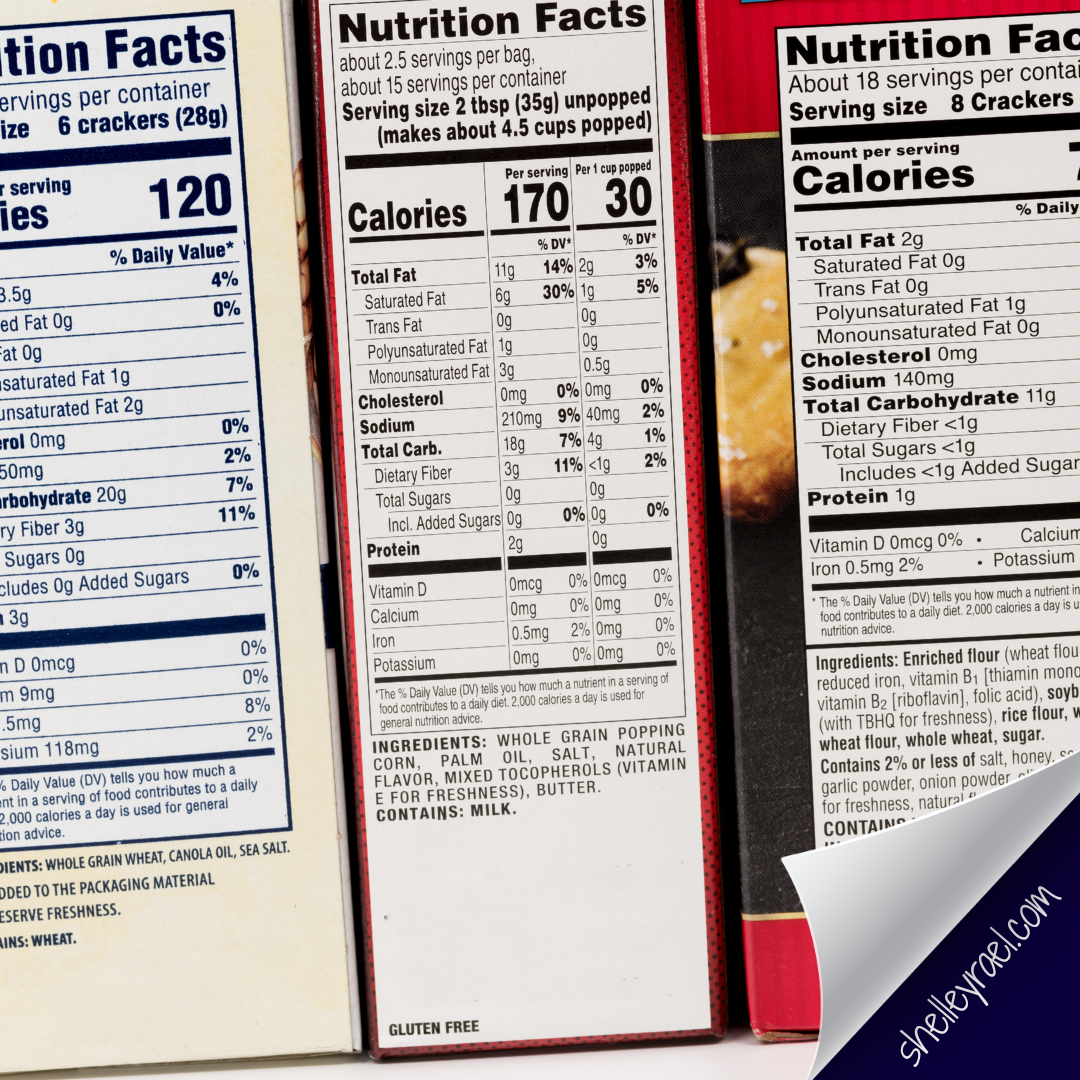
Serving size is one of the most misunderstood parts of the entire label. The serving size does not tell you how much you should eat – or limit yourself to. It is not a personalized recommendation. It is simply the amount that people typically eat based on survey data. That is it.
When labels were introduced in the 1990s, serving sizes reflected eating patterns from that time. This is where the old half-cup serving of ice cream came from. People love to make fun of that number, but that was the documented average at that time (shocking, I know). Eating patterns have changed, so the updated label uses a two-thirds cup serving instead. I don’t know. That still seems small when some of those containers feel like a single service. You can still eat more or less – it’s your choice. The label is not judging you. It’s a package, not a person.
Serving size exists for one main reason. Every single number you see on that entire Nutrition Facts panel is based on that serving size. If you eat double, the calories and nutrients double. If you eat half, the numbers drop accordingly. This is where basic math comes in, which makes some people roll their eyes, but it really is that simple.
The updated panel uses a larger, bolder font for the serving size to make it easier to notice. It is not the biggest thing on the label, but it stands out more than it used to.
Servings Per Container
Right above the serving size is servings per container. This one catches people off guard more than almost anything else. Again, based on my 25+ years of experience.
That package that looks like a single serving might not be one serving. A package of ramen noodles has two servings (usually – look next time). A box of macaroni and cheese has three. (Can you tell that I teach college students?) A regular bag of M&M's, or what I once thought was a single-serving package, technically has two servings. And yes, the label may say “tear and share.” No, most people do not share. I know I don’t.
Serving size times servings per container gives you a general idea of how much is in the package. Meaning that if the serving size is ¼ cup and there are 8 servings per container, that would be 2 cups. This is how I once ended up trying to figure out how many chocolate chips were in a giant Costco bag. The label said there were about 136 servings, each 15 grams. That is roughly 2 kilograms of chocolate chips. Whether that equals 4,080 chocolate chips or not, who knows, but it tells me what is in the bag from a nutrition standpoint. I did this for education, not to be uptight.
Some package sizes have also changed their listed serving counts to reflect how people actually consume them. A 20-ounce soda used to be listed as 2.5 servings because 8 ounces was considered a serving. Now the whole bottle is listed as one serving. Again, this is not a recommendation. It simply reflects typical intake patterns.
Calories
Now for the number that gets the most attention – at least the one I will point out more often – at the top of the Nutrition Facts panel: calories. Calories are printed in the biggest, boldest font on the panel. The idea was that people were ignoring or just not seeing the calorie information, so now it is nearly impossible to miss, or one has to actively ignore it.
Calories are just a measure of energy. Not moral value. Not a grade on your choices. Just energy.
If you eat the serving size listed, you get the calories listed there (more or less – I’ll get to that). If you eat more, you get more. Nothing complicated here. The only thing worth noting is that calorie values are averages. There can be about a 20 percent swing in either direction, or that is normal. Foods vary. Ingredients vary. Even homemade food varies from batch to batch. Those muffins or cookies won’t have the same amount of calories exactly.
So if a serving of chocolate chips says 70 calories, it might be closer to 56 or 84. The difference is slight and not worth stressing over. Same with that bag of M&M's. The real number will not be the exact number printed, and that is fine. Really, it is! This is not food manufacturers trying to sneak anything past you. It is simply how food works. Consider if you had a fruit tree in your yard – let’s say a peach tree – I guarantee that those peaches have different calorie counts, because, like humans, we are all a bit different.
There is already enough stress around eating. Variability in calories does not need to be added to the list.
What Is Next
This is just the top three lines of the Nutrition Facts panel. So, next week we will look at fats, cholesterol, carbohydrates, and protein, and how to use those sections of the label without making yourself crazy.
Real World Nutrition Refreshed: I am revitalizing and updating my blog archive and re-publishing it. Stay tuned as I review, update, refresh, and re-share these posts to provide you with even more valuable information on nutrition, health, and overall wellness—and keep things timely. A portion of this blog was initially posted on January 25, 2022, and has been updated here.